Why Users Should Know What a System Does, Not How It Does It
Abstraction is often misunderstood because it is taught as a Java construct rather than a human idea.
When students first hear about abstraction, they are shown interface and abstract class, and the discussion immediately turns technical.
But abstraction did not originate from Java.
Java only implements an idea that already existed long before programming languages.
To understand abstraction properly, we must first understand why humans need it at all.

What Does Abstraction Really Mean?
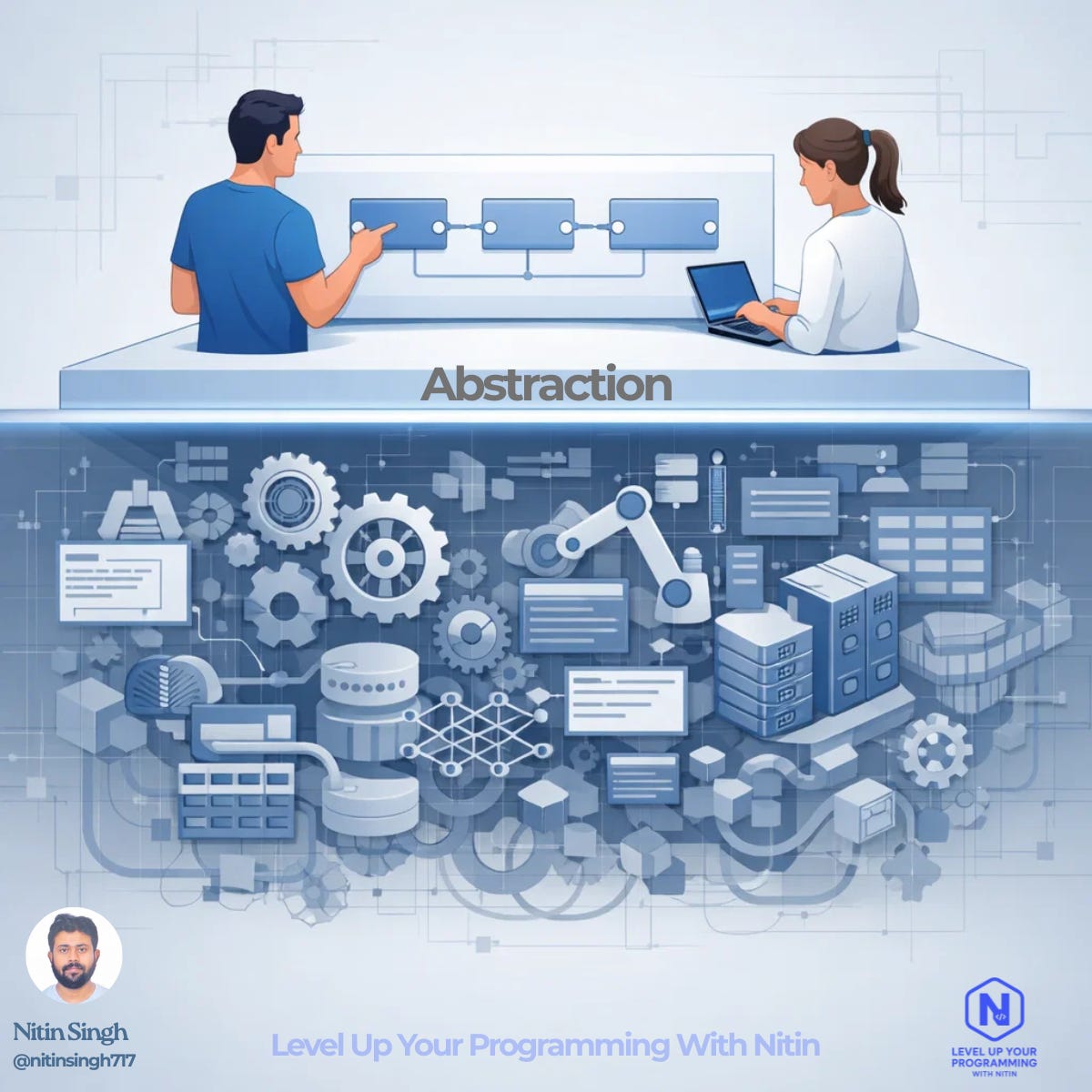
Abstraction means deliberately ignoring unnecessary details in order to focus on what truly matters.
This is not ignorance.
This is intelligent filtering.
When a system grows large, it becomes impossible for a human mind to understand everything at once. Abstraction allows us to say:
“I don’t need to know how this works.
I only need to know what it guarantees.”
This shift—from mechanism to promise—is the foundation of abstraction.
How We Naturally Use Abstraction in Real Life
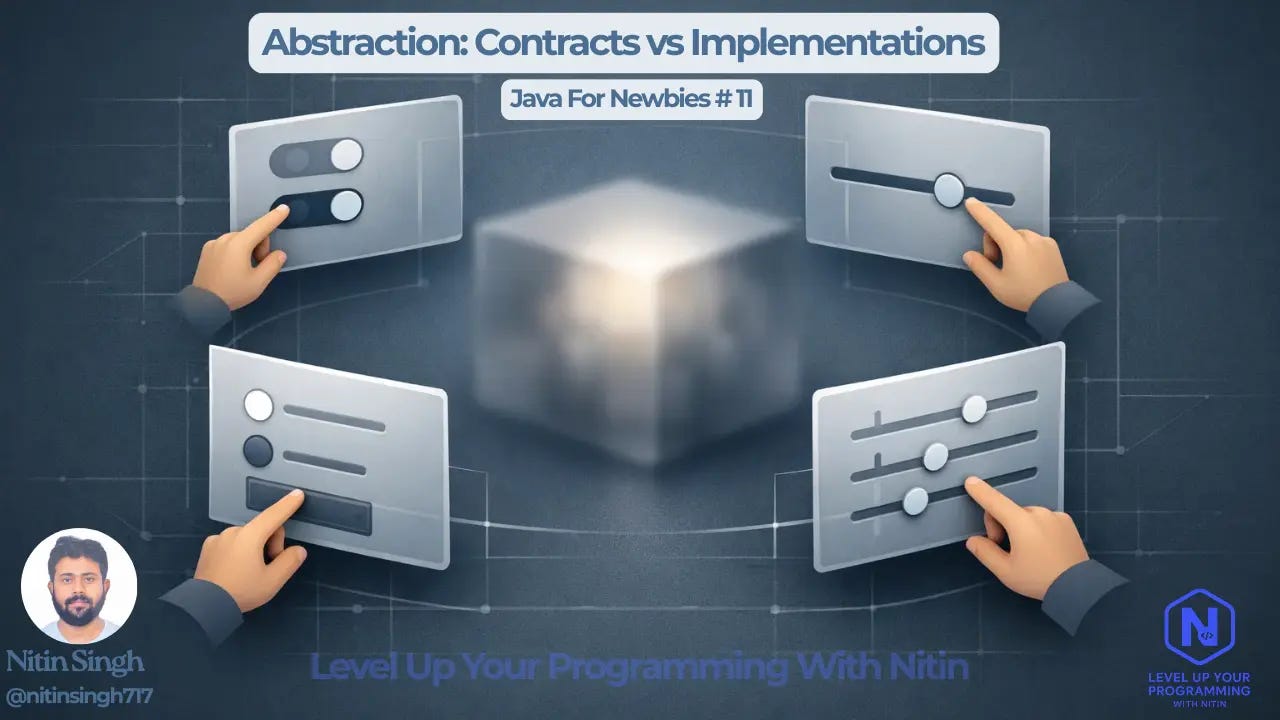
Consider something extremely simple: a switch.
When you press a switch, the light turns on.
When you press it again, the light turns off.
That is all you know — and that is all you need to know.
You do not know:
How electricity flows through the wires
How the wiring is arranged inside the walls
How the bulb converts electrical energy into light
And you don’t need to.
The switch represents a contract:
If you press me, light will appear.
Everything else — wiring, circuits, electrical laws, physics — are implementation details.

Now imagine that tomorrow the house is upgraded:
Traditional wiring is replaced with smart wiring
Bulbs are replaced with smart lights
Control logic moves to a central system
As a user, nothing should change.
You still press the switch.
The light still turns on.
That separation — promise versus mechanism — is abstraction.
Why Abstraction Became Necessary in Software
Early programs were small.
One developer could understand the entire codebase.
As software evolved:
Programs became massive
Teams grew larger
Systems became long-living
At that point, a serious problem appeared.
If every user of a component needed to understand:
Its internal data structures
Its algorithms
Its performance tricks
Then software development would not scale.
Abstraction emerged as a solution to human limitation.
It allows developers to say:
“Use this component based on its promise.
Trust that the internal details are handled.”
Without abstraction, every change would ripple across the system, breaking everything in its path.
Contracts vs Implementations (The Core Philosophy)
At the heart of abstraction lies a simple separation:
Contract → What the system promises to do
Implementation → How the system actually does it
The user of a system should depend only on the contract.
The implementer is free to:
Change algorithms
Optimize performance
Rewrite internal logic
As long as the contract is honored, the system remains stable.
This idea is not optional in large software.
It is mandatory for survival.
A Powerful Java Example: List and sort()
Now let us see abstraction in action in Java.
You use the List interface every day.
List<Integer> numbers = new ArrayList<>();
numbers.add(5);
numbers.add(2);
numbers.add(8);

Collections.sort(numbers);
Pause here and think.
When you call sort():
Do you know which sorting algorithm is being used?
Do you know why that algorithm was chosen?
Do you know when or how Java might switch strategies internally?
Most of the time, you don’t — and that is intentional.
What you rely on is the contract:
If I call
sort(), the elements will be sorted according to their natural order.
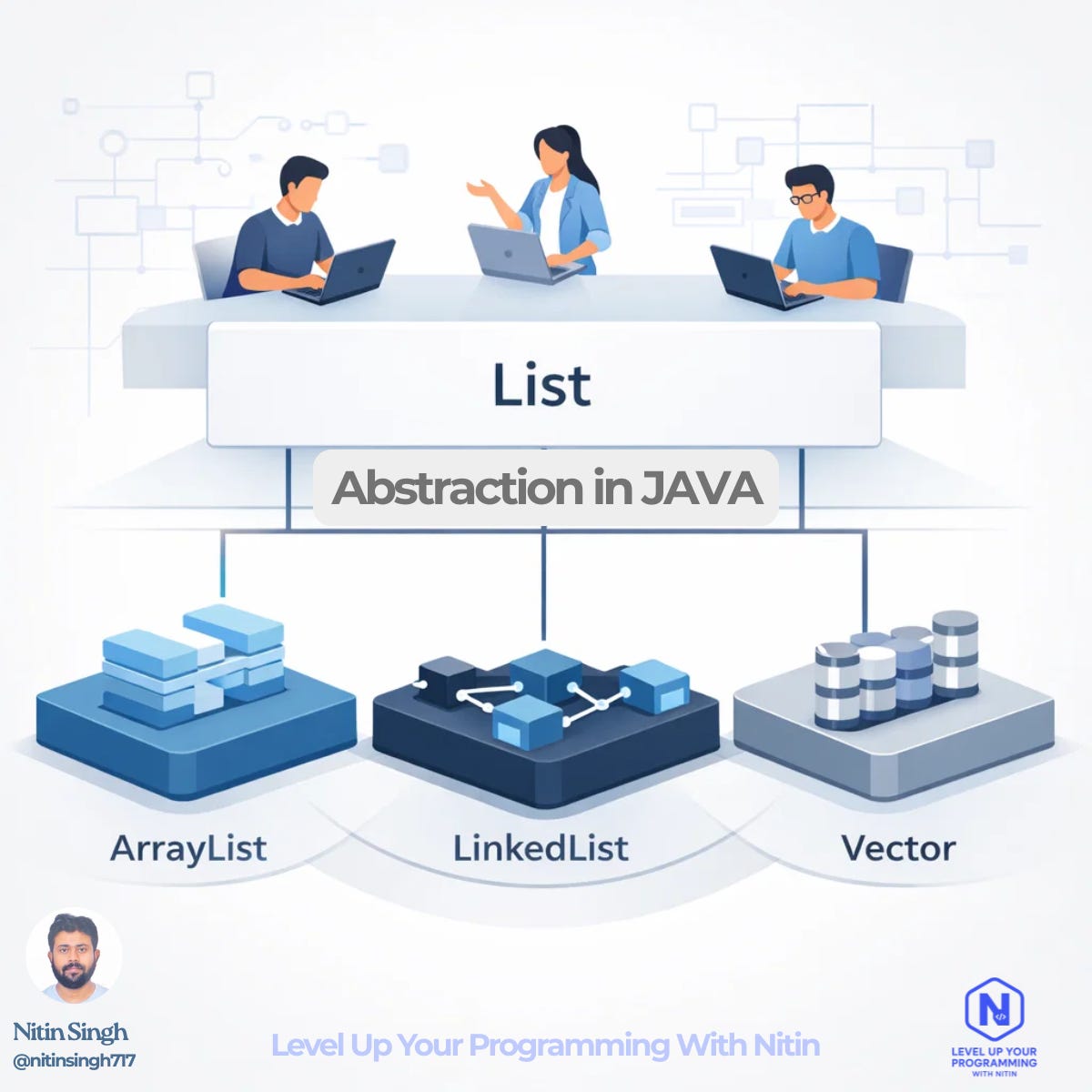
Internally, Java is free to:
Choose different algorithms
Optimize based on data size
Change implementations across versions
Your code remains correct because it depends only on the guarantee, not the mechanism.
That is abstraction done right.
Abstraction in Java (Conceptual View)
In Java, abstraction is not about creating many classes.
It is about controlling what different users are allowed to see and use, while keeping the underlying implementation stable.
Let us understand this through a practical situation.
Imagine you have built a calculator engine.
Internally, it supports four operations:
Addition
Subtraction
Multiplication
Division
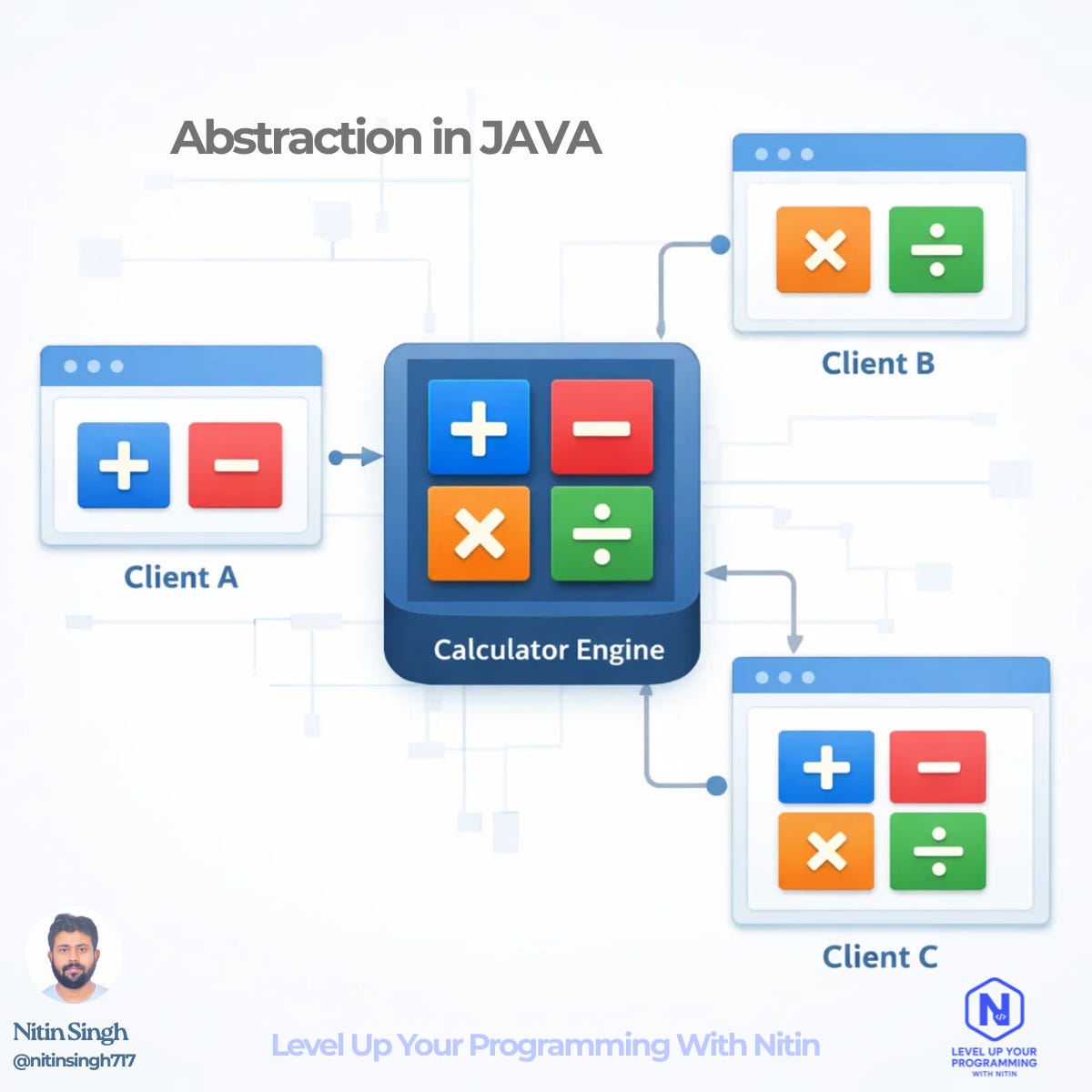
Now imagine you have three different clients:
Client A pays for a basic plan → needs only addition and subtraction
Client B pays for another plan → needs only multiplication and division
Client C pays for the premium plan → needs all four operations
The important question is:
Should you create three different calculator classes?
No.
The calculator logic is the same.
Only access to functionality differs.
This is exactly where abstraction helps.
Step 1: Define Contracts (What Each Client Is Allowed to Do)
interface BasicCalculator {
    int add(int a, int b);
    int subtract(int a, int b);
}
interface AdvancedCalculator {
    int multiply(int a, int b);
    int divide(int a, int b);
}
These interfaces represent contracts.
They define what operations are available, not how they are implemented.
Step 2: One Concrete Implementation (How Everything Is Done)
class Calculator implements BasicCalculator, AdvancedCalculator {

    public int add(int a, int b) {
        return a + b;
    }

    public int subtract(int a, int b) {
        return a - b;
    }

    public int multiply(int a, int b) {
        return a * b;
    }

    public int divide(int a, int b) {
        if (b == 0) {
            throw new IllegalArgumentException("Division by zero");
        }
        return a / b;
    }
}
Notice something important:
There is only one concrete class
All logic lives in one place
No duplication
No confusion
Step 3: Different Clients, Different Views of the Same System
BasicCalculator basicUser = new Calculator();
basicUser.add(5, 3);
basicUser.subtract(10, 4);
This user cannot access multiplication or division.
AdvancedCalculator advancedUser = new Calculator();
advancedUser.multiply(4, 5);
advancedUser.divide(20, 4);
This user cannot access addition or subtraction.
Calculator premiumUser = new Calculator();
premiumUser.add(2, 3);
premiumUser.multiply(3, 4);
This user has access to everything.
What This Example Teaches
This example shows the true power of abstraction:
The same implementation serves different users
Access is controlled by contracts, not by condition checks
Clients depend only on what they are allowed to use
Implementation can change without affecting users
This is abstraction in its purest form:
Different views of the same system, controlled by contracts.
One Line to Remember
Abstraction is not about hiding code —
it is about exposing only what the user needs.
💼 Crack the Interview — Abstraction
1. What is abstraction in Java?
Abstraction is the process of exposing only essential behavior while hiding implementation details.
2. Why is abstraction important?
It manages complexity and allows systems to evolve safely.
3. How is abstraction achieved in Java?
Using interfaces and abstract classes.
4. What is the difference between abstraction and encapsulation?
Encapsulation protects data; abstraction controls what behavior is visible.
5. Give a real-world Java example of abstraction.
The List interface — users rely on its contract without knowing internal implementations.
Strong Interview Line:
Abstraction lets us depend on guarantees, not on algorithms.
Let’s Stay Connected
If you found this helpful, stay connected — Through Level Up Your Programming with Nitin, I share guides, insights, and live coding sessions to help you grow as a developer.
Let’s keep learning together!
Feel free to like, comment, or share your thoughts below — I’d love to hear how your Java journey is going.
Nitin
Hashnode | Substack | LinkedIn | Youtube | Instagram | GIT | Topmate