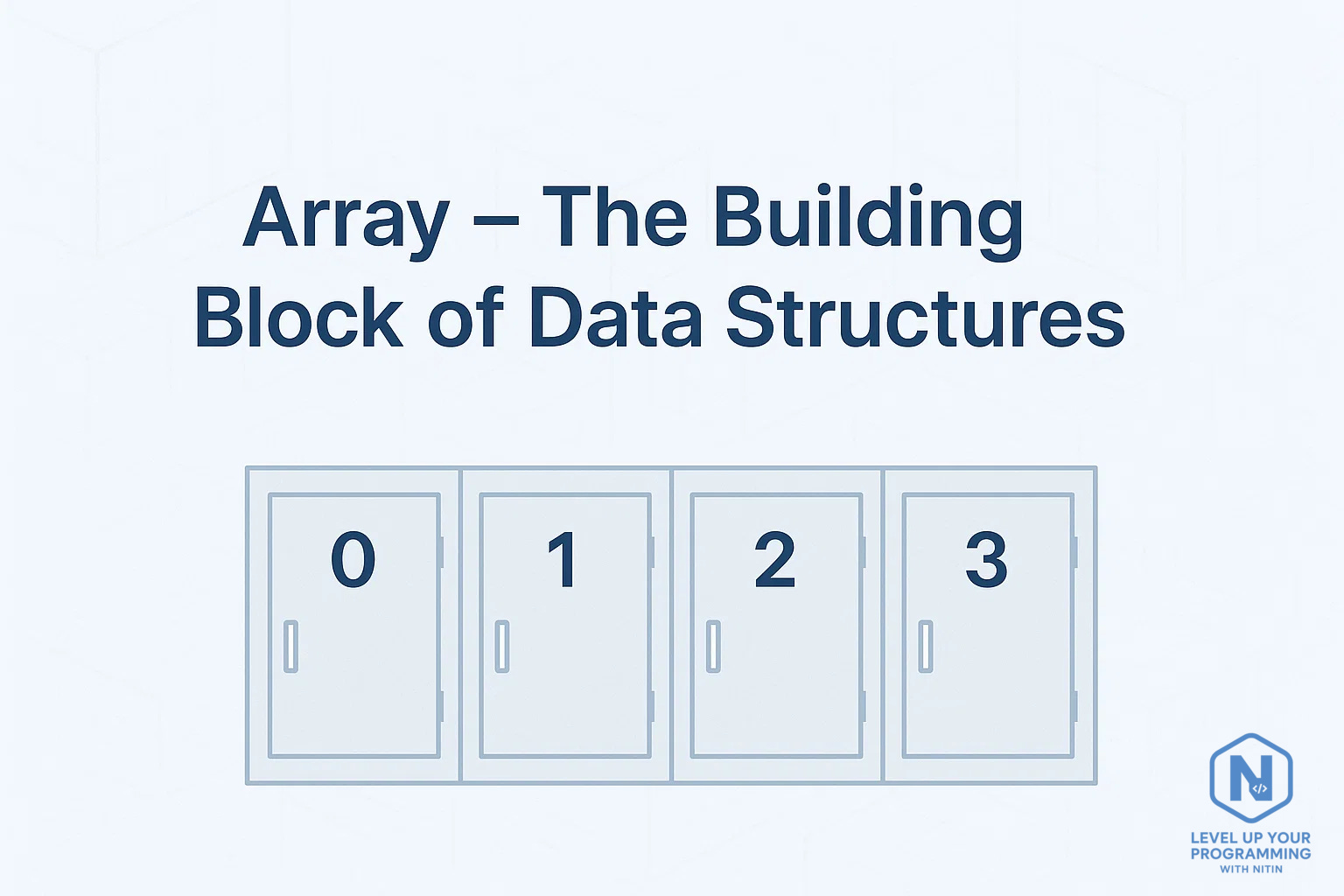
Array – The Building Block of Data Structures
DS#1-> Understanding Arrays: The First Step to Mastering Data Structures

🧠 What is an Array?
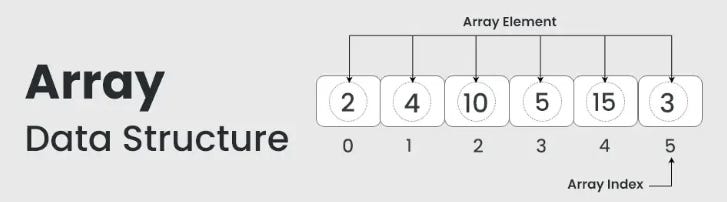
An Array is a linear data structure that stores elements in contiguous memory locations. Each element is of the same data type and can be accessed using a unique index, starting from 0.
Think of an array as a row of lockers — each with a number (index) and space for a single item (value).
💡 Why Are Arrays Important?
Arrays are foundational in computer science and appear in almost every algorithm or system.
Easy and fast access via index – O(1) time.
Basis for many other structures (like matrices, heaps, hash tables).
Universally supported in programming languages.
🛠️ Common Array Operations
Here's a breakdown of basic array operations:
Access → Get element by index →
O(1)Search → Find if a value exists →
O(n)Insert at end → Add item at the end (if space) →
O(1)Insert at index → Shift elements and insert →
O(n)Delete → Remove element and shift others →
O(n)
🧪 Java Example
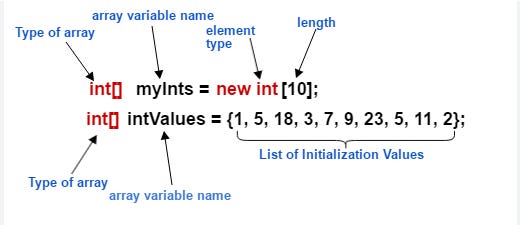
int[] nums = {10, 20, 30, 40, 50};
System.out.println(nums[2]);  // Output: 30
This creates an array of 5 integers and prints the value at index 2.
🔍 Memory Layout (Deep Dive)
Arrays are stored in contiguous memory blocks, which means the elements are placed one after another in memory.
This layout allows instant address calculation using the formula:
Address[i] = base_address + (i × size_of_element)
Where:
base_address= memory address of the first element (e.g.,arr[0])i= indexsize_of_element= number of bytes per element (e.g., 4 bytes forintin Java)
🔧 Example
int[] arr = {10, 20, 30, 40, 50};
Assuming arr[0] starts at memory address 1000 and each integer takes 4 bytes, the memory layout would be:
arr[0] = 10→ Address:1000arr[1] = 20→ Address:1004arr[2] = 30→ Address:1008arr[3] = 40→ Address:1012arr[4] = 50→ Address:1016
Each element is exactly 4 bytes apart.
⚡ Why Is This Important?
Fast Access: You don’t need to search — just do a quick calculation to jump to the correct address.
Low Overhead: Arrays have no internal pointers or metadata between elements, making them efficient in space and speed.
Better Cache Performance: Since elements are stored next to each other, CPUs can prefetch adjacent elements — speeding up iteration.
⚠️ Limitation of Arrays
Arrays are static in size. Once allocated, the size cannot change.
When you need dynamic resizing, use structures like ArrayList or Vector.
🧠 Common Interview Questions (Array-Based)
Here are a few classic problems that test your understanding of arrays:
Two Sum – LeetCode #1
Best Time to Buy and Sell Stock – LeetCode #121
Maximum Subarray (Kadane's Algorithm) – LeetCode #53
Move Zeroes – LeetCode #283
Contains Duplicate – LeetCode #217
These problems focus on array manipulation, iteration, and pattern recognition.
📝 Tips for Interview Prep
✅ Master the Basics: Make sure you're confident with array indexing, iteration patterns, and common pitfalls like off-by-one errors.
🔄 Learn Two-Pointer & Sliding Window Techniques: These patterns are extremely common in array problems (e.g., finding subarrays, reversing arrays, searching for pairs).
💭 Understand Time & Space Trade-offs: Know when to use brute force, when to optimize with prefix sums, and how extra space (like hash sets) can speed things up.
🧮 Practice Pattern Recognition: Many array problems follow templates—like Kadane’s for max subarrays or sliding window for dynamic ranges. Recognizing these helps solve problems faster in interviews.
🧰 Know Built-in Tools: Familiarize yourself with language-specific tools (
Arrays.sort(),System.arraycopy(), orCollectionsutilities in Java) that simplify code.🧪 Dry Run Your Code: Always simulate a few steps manually to validate your logic, especially in problems involving loops and conditions.
🧠 Revisit Problems After Solving: Solve the same LeetCode problem again after a few days — this improves retention and clarity of logic.
🙌 Wrapping Up
Arrays might be the simplest data structure, but they’re the foundation upon which many advanced structures are built. Mastering arrays means getting comfortable with indexing, traversals, and memory layout — all of which are essential for cracking coding interviews.
I hope this guide helped you gain a deeper understanding of how arrays work and how they’re used in real-world problems and interview scenarios. Have questions or want to share your thoughts? Drop a comment — I’d love to hear from you!
📬 Stay updated: This post is part of a complete blog series on essential data structures.
Nitin
Hashnode | Substack | LinkedIn | GIT | Youtube | Instagram