
🧭 Introduction
Heaps are specialized binary trees that maintain a specific order, enabling fast access to the highest (or lowest) priority element. Heaps play a critical role in solving problems involving priority queues, scheduling, and streaming data, where performance is crucial.
In this blog, we'll explore the fundamentals of heaps, their types, key operations, how they're stored in memory, and how to tackle heap-related questions during interviews.
🧱 What is a Heap?
A Heap is a complete binary tree that satisfies the heap property:
Max-Heap: Every parent node is greater than or equal to its children.
Min-Heap: Every parent node is less than or equal to its children.
Unlike a Binary Search Tree (BST), heaps do not follow the left < root < right order. Their focus is maintaining the max/min element at the top (root).
🧩 Types of Heaps
Max-Heap – The root node is the maximum element, and every child node is smaller than its parent.
Min-Heap – The root node is the minimum element, and every child node is larger than its parent.
Binary Heap – The most common heap structure, usually implemented as a binary tree.
Fibonacci Heap – An advanced heap offering better amortized time complexity for some operations.
Binomial Heap – Efficient for merging heaps; often studied in theoretical computer science.
💡For coding interviews, the focus is typically on Min , Max and Binary Heaps.
⚙️ Heap Operations
Here are the most common operations and their time complexities:
1. insert()
Description: Add an element to the heap
Time Complexity: O(log n)
2. peek() / top()
Description: Retrieve the root element (max or min) without removing it
Time Complexity: O(1)
3. remove()
Description: Remove the root and reheapify
Time Complexity: O(log n)
4. heapify()
Description: Build a heap from an unsorted array
Time Complexity: O(n)
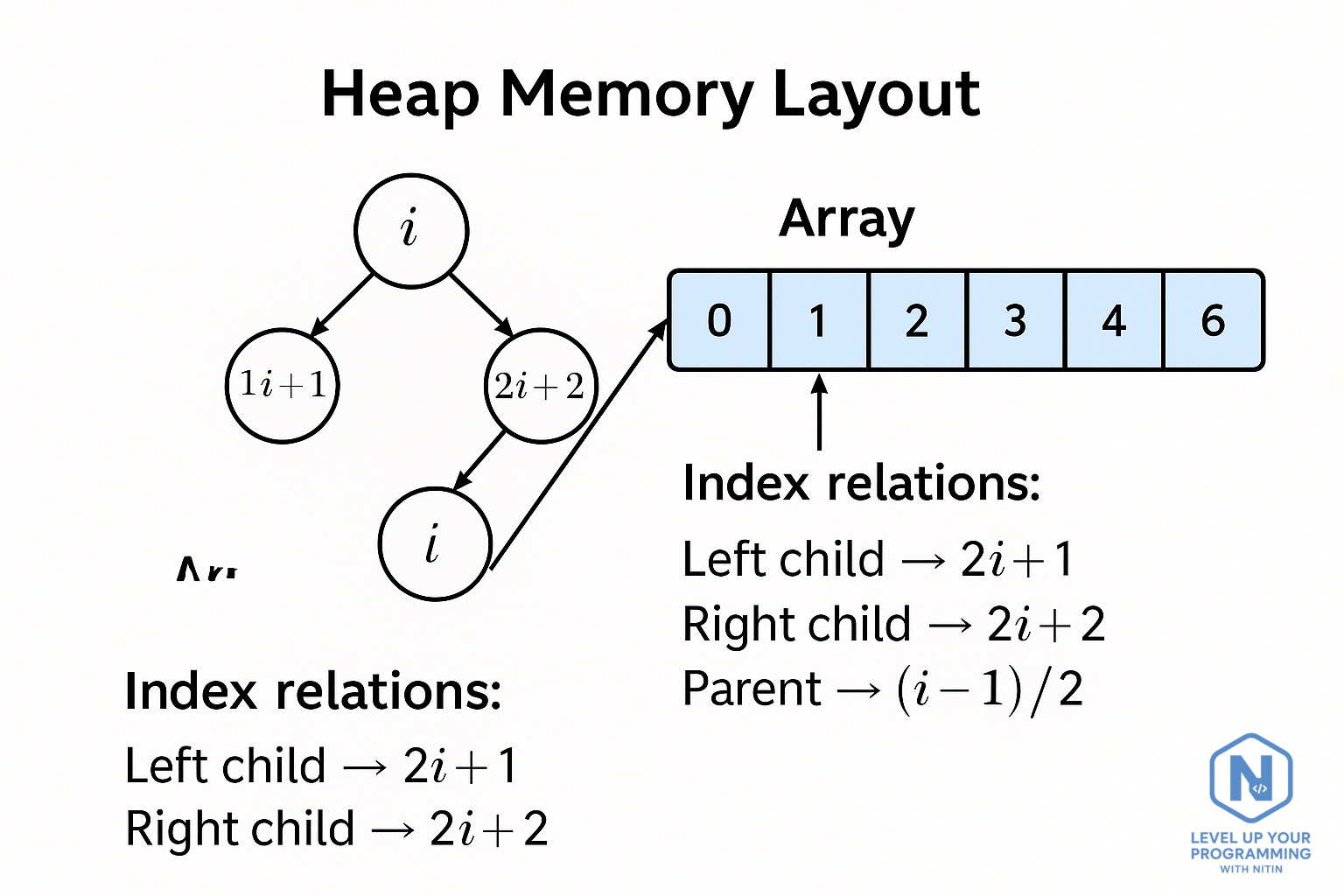
🧠 Heap Memory Layout
Heaps are implemented using arrays because:
A complete binary tree can be efficiently mapped to an array without gaps.
No need for explicit node pointers like in trees.
Index relations:
For node at index
i:Left child →
2*i + 1Right child →
2*i + 2Parent →
(i - 1) / 2
This structure ensures cache-friendly memory access and minimal overhead.
Java Example: Min-Heap Using PriorityQueue
import java.util.PriorityQueue;

public class MinHeapExample {
    public static void main(String[] args) {
        PriorityQueue<Integer> minHeap = new PriorityQueue<>();

        minHeap.add(10);
        minHeap.add(4);
        minHeap.add(15);
        minHeap.add(1);

        System.out.println("Min element: " + minHeap.peek()); // Output: 1
    }
}
In Java
PriorityQueueis a Min-Heap by default.
🚀 Applications of Heaps
Priority Queue implementation
Dijkstra’s algorithm (shortest path)
Heap Sort
Median in streaming data
Top K elements problems
Job Scheduling
🧠 Common Patterns
Kth Largest/Smallest Element – Using a min/max heap.
Merge K Sorted Lists/Arrays – Use a min-heap to efficiently merge.
Streaming Median – Two heaps to maintain balance.
Top K Frequent Elements – Min-heap based counting.
🧪 LeetCode Practice Problems
Kth Largest Element in an Array – Medium – LeetCode#215
Top K Frequent Elements – Medium – LeetCode#347
Merge k Sorted Lists – Hard – LeetCode#23
Find Median from Data Stream – Hard – LeetCode#295
Minimum Cost to Connect Sticks – Medium – LeetCode#1167
Last Stone Weight – Easy – LeetCode#1046
💡 Tips for Interview Prep
💬 Know when to use min-heap vs max-heap.
🧮 Focus on index math when implementing heap manually.
🔄 Practice converting arrays into heaps (heapify).
🔁 Understand how PriorityQueue works in Java, including custom comparators.
⛏️ Be prepared to implement a heap from scratch.
🧊 Corner case awareness: empty heap, duplicate values, and custom object heaps.
📚 Don’t forget Java's
PriorityQueueis a Min-Heap by default.
🔚 Wrapping Up
Heaps offer an elegant solution for problems that demand quick access to the smallest or largest element. They might not come up in every interview, but when they do — they often unlock efficient and elegant solutions.
Whether you're building a priority queue, merging data, or designing a real-time system, heaps are a tool you’ll want in your arsenal.
👉 Practice a few heap problems , and you’ll quickly get the hang of it!
Happy coding! 🚀
Nitin
Hashnode | Substack | LinkedIn | GIT | Youtube | Instagram