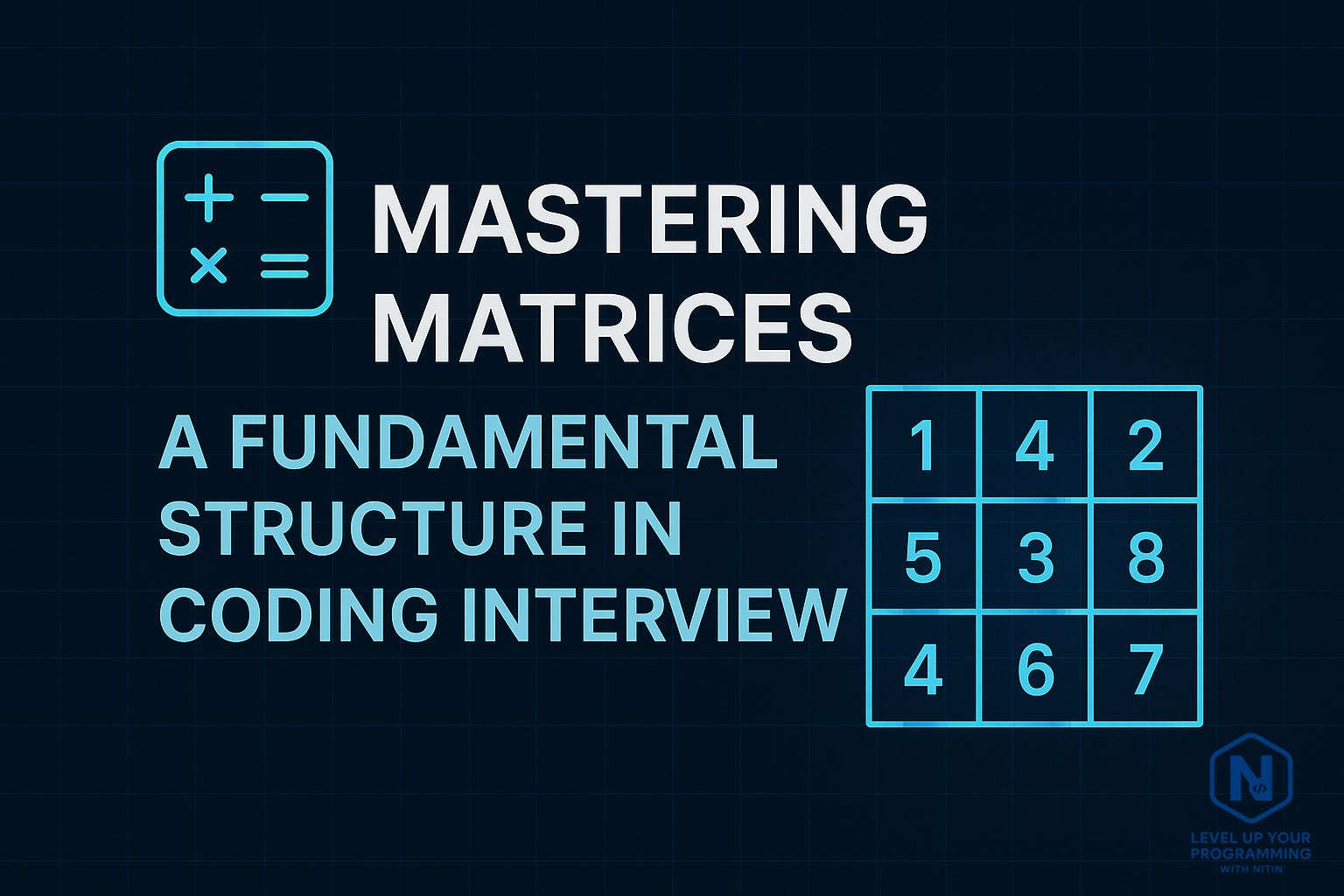
Matrices (or 2D arrays) are an essential extension of arrays and a common topic in technical interviews. They represent grids or tables and are used in problems ranging from image processing to pathfinding.
📘 What is a Matrix?
A matrix is essentially an array of arrays. It’s a collection of elements arranged in rows and columns — a rectangular grid.
For example:
int[][] matrix = {
  {1, 2, 3},
  {4, 5, 6},
  {7, 8, 9}
};

Here, matrix[0][0] is 1, and matrix[2][2] is 9.
🧠 Memory Layout of a Matrix
Although a matrix is visually 2D, in memory it's stored linearly (like a 1D array). Each row follows the previous row.
For a 3x3 matrix:
Visual:
[1, 2, 3]
[4, 5, 6]
[7, 8, 9]

Memory:
[1, 2, 3, 4, 5, 6, 7, 8, 9]
This is why it's possible to flatten a matrix and access it as matrix[row * cols + col] in some languages.
In Java, a 2D array is implemented as an array of references to arrays, meaning each row can technically have a different length — called a jagged array.
🔁 Common Matrix Traversal Patterns
1. Row-wise and Column-wise Traversal
This is the most common and straightforward matrix traversal method.
for (int i = 0; i < matrix.length; i++) {
  for (int j = 0; j < matrix[0].length; j++) {
    System.out.print(matrix[i][j] + " ");
  }
  System.out.println();
}
2. Diagonal Traversal (Top-Left to Bottom-Right)
int m = matrix.length;
int n = matrix[0].length;

for (int k = 0; k < m + n - 1; k++) {
  int row = (k < n) ? 0 : k - n + 1;
  int col = (k < n) ? k : n - 1;

  while (row < m && col >= 0) {
    System.out.print(matrix[row][col] + " ");
    row++;
    col--;
  }
  System.out.println();
}
3. Spiral Traversal (Clockwise)
int top = 0, bottom = matrix.length - 1;
int left = 0, right = matrix[0].length - 1;

while (top <= bottom && left <= right) {
  // Traverse from Left to Right
  for (int i = left; i <= right; i++)
    System.out.print(matrix[top][i] + " ");
  top++;

  // Traverse from Top to Bottom
  for (int i = top; i <= bottom; i++)
    System.out.print(matrix[i][right] + " ");
  right--;

  if (top <= bottom) {
    // Traverse from Right to Left
    for (int i = right; i >= left; i--)
      System.out.print(matrix[bottom][i] + " ");
    bottom--;
  }

  if (left <= right) {
    // Traverse from Bottom to Top
    for (int i = bottom; i >= top; i--)
      System.out.print(matrix[i][left] + " ");
    left++;
  }
}
4. Boundary Traversal (Outer Edge of Matrix)
int rows = matrix.length;
int cols = matrix[0].length;

// Top row
for (int i = 0; i < cols; i++)
  System.out.print(matrix[0][i] + " ");

// Right column
for (int i = 1; i < rows; i++)
  System.out.print(matrix[i][cols - 1] + " ");

// Bottom row
if (rows > 1) {
  for (int i = cols - 2; i >= 0; i--)
    System.out.print(matrix[rows - 1][i] + " ");
}

// Left column
if (cols > 1) {
  for (int i = rows - 2; i > 0; i--)
    System.out.print(matrix[i][0] + " ");
}
🧮 Common Algorithms and Use Cases
Matrix Transpose
Rotate a matrix 90 degrees
Search in a sorted matrix
Set matrix zeroes (in-place mutation)
These are all frequent interview topics.
🧠 Common Interview Questions (2D Arrays & Matrices)
Here are some classic matrix-based problems that test your understanding of 2D array traversal, in-place operations, and recursive backtracking:
Search a 2D Matrix – LeetCode #74
Rotate Image (in-place 90° rotation) – )LeetCode #48
Set Matrix Zeroes – LeetCode #73
Spiral Matrix – LeetCode #54
Word Search – LeetCode #79
📝 Tips for Interview Prep
🧭 Understand Coordinates: Many bugs happen because of confusion between
i(rows) andj(columns).🔁 Master Traversal Patterns: Be comfortable with spiral, diagonal, and boundary traversals.
🧠 Think in Layers: Many problems (like rotate/spiral) work best when you think layer by layer (top, bottom, left, right).
⏱️ Know Time/Space Tradeoffs: In-place changes vs. extra space is a common discussion point.
💡 Practice Backtracking: Problems like Word Search teach you recursion inside a matrix.
🙌 Wrapping Up
Matrices extend the concept of arrays into two dimensions, enabling us to model grids, images, game boards, and more. Mastering matrix manipulation is crucial for solving real-world problems in image processing, dynamic programming, and search algorithms.
By understanding common traversal techniques (row-wise, column-wise, spiral, diagonal), in-place transformations, and recursive backtracking, you’ll be well-prepared for both interviews and practical coding challenges.
Keep practicing—these problems often look complex at first, but they follow recognizable patterns once you know what to look for.
📬 This post is part of the Data Structures series.
👉 Subscribe to get new posts directly in your inbox.
Nitin
Hashnode | Substack | LinkedIn | GIT | Youtube | Instagram