“To understand recursion, one must first understand recursion.” – Anonymous
Cracking Recursion – Think Smaller, Solve Bigger
🧠 Introduction
Recursion is one of the most fundamental and powerful techniques in programming. It's not just a coding trick—it’s a way of thinking. Recursion simplifies complex problems by breaking them into smaller, similar sub-problems.
It is heavily used in algorithms like divide-and-conquer (e.g., merge sort, quick sort), backtracking (e.g., N-Queens, Sudoku Solver), and tree/graph traversal. Understanding recursion is essential not only for coding interviews but for mastering the art of algorithmic thinking.
🔍 What is Recursion?
Recursion is a programming technique where a function calls itself to solve smaller instances of a problem.
A recursive function generally follows two rules:
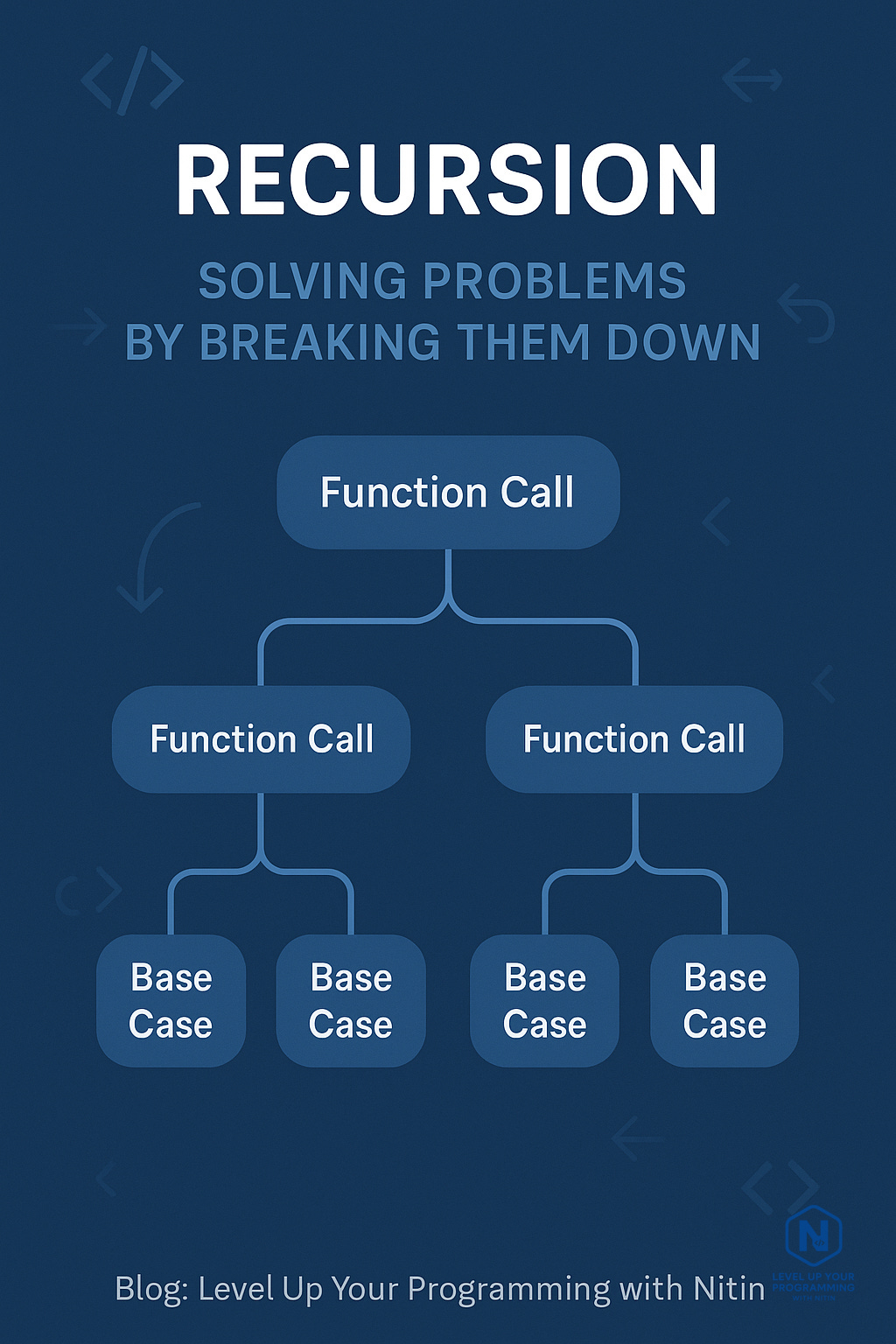
Base Case – the condition under which the recursion ends.
Recursive Case – where the function calls itself with modified parameters.
Let’s understand with a simple example:
// Java example: Factorial using recursion
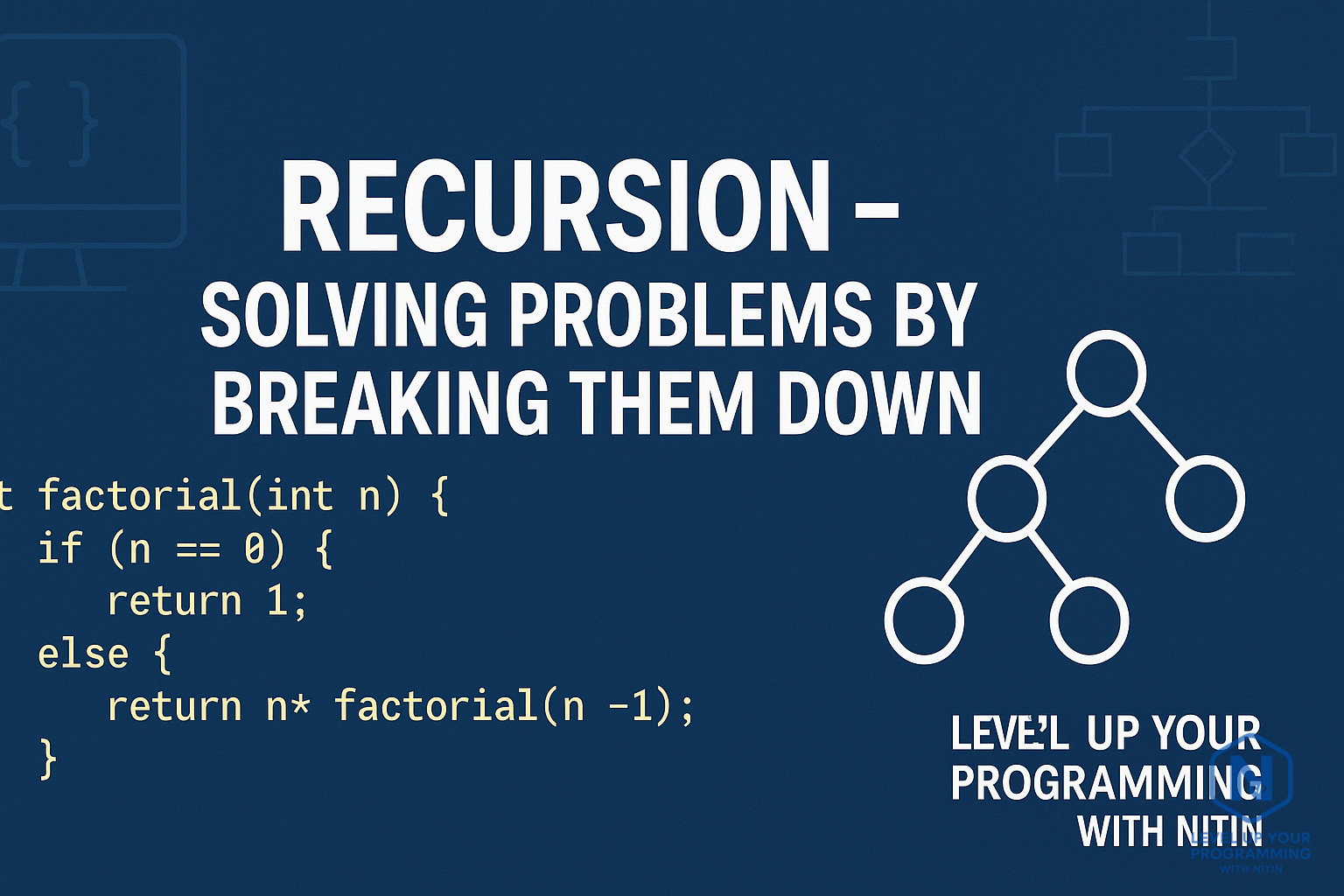
int factorial(int n) {
    if (n == 0) return 1; // Base Case
    return n * factorial(n - 1); // Recursive Case
}
Calling factorial(4) leads to:
4 * factorial(3)
   → 3 * factorial(2)
      → 2 * factorial(1)
         → 1 * factorial(0)
            → return 1
Each recursive call waits for the result of the next, forming a call stack.
🔄 How Recursion Works (Behind the Scenes)
Every time a recursive function is called, a new frame is added to the call stack. This frame holds:
The function’s arguments.
Local variables.
The return address to resume execution after the recursive call.
As the base case is reached, these frames start resolving one by one (stack unwinds).
Memory Representation:
factorial(4)
└── factorial(3)
    └── factorial(2)
        └── factorial(1)
            └── factorial(0) → returns 1
Note: If the base case is not defined or reachable, the recursion will result in a StackOverflowError.
⚖ Base Case and Recursive Case
Let’s break this down further with another example – computing the sum of first n natural numbers.
int sum(int n) {
    if (n == 1) return 1;           // Base Case
    return n + sum(n - 1);          // Recursive Case
}
Base case ensures that the function terminates.
Recursive case breaks the problem down into smaller subproblems.
🧱 Stack Memory Visualization
Here’s a simplified visualization of how the stack behaves for:
sum(3)
CALL STACK:
→ sum(3) waits for sum(2)
   → sum(2) waits for sum(1)
      → sum(1) returns 1

Unwinding:
← sum(2) = 2 + 1 = 3
← sum(3) = 3 + 3 = 6
Each function call takes space in memory, and too many calls can overflow the stack. This is why tail recursion and optimization is important.
🧨 Common Mistakes in Recursion
❌ Forgetting the base case.
❌ Incorrect base case logic.
❌ Modifying input incorrectly in recursive calls.
❌ Not returning values properly.
❌ Expecting recursion to automatically be efficient.
Fix: Always trace small inputs on paper before coding.
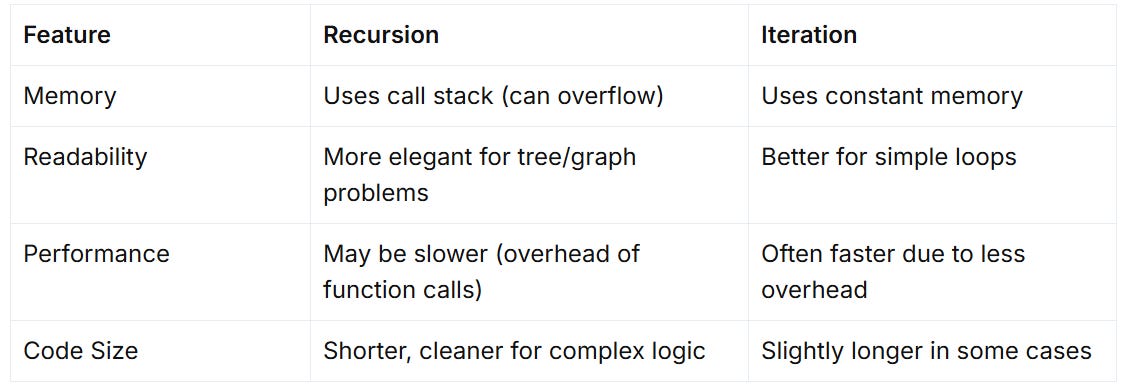
🔁 Recursion vs Iteration
🧪 LeetCode Practice Problems
🔥 Top Recursion & Backtracking Problems (Must-Practice)
Factorial Function – Easy – LeetCode#172
Climbing Stairs – Easy – LeetCode#70
💼 Tips for Interview Prep
Tips for Acing Recursion Questions in Interviews
Start Simple: Begin with straightforward recursion problems to build confidence and clarity around base and recursive cases.
Visualize the Call Stack: Drawing the recursion tree helps you track function calls and understand how the problem breaks down.
Explain Your Thought Process: Clearly describe the flow of recursion and how each call returns during mock interviews or real ones.
Practice Backtracking: Since many complex recursion problems involve backtracking, focus on mastering this technique.
Avoid Memorization: Concentrate on truly understanding how recursion works instead of just memorizing solutions.
Use Examples: Walk through small input examples step-by-step to solidify your grasp.
Handle Edge Cases: Think about and discuss base cases and potential pitfalls to show depth of knowledge.
Write Clean Code: Keep your recursive functions concise and readable, demonstrating best coding practices.
🔚 Wrapping Up
Recursion isn’t just a tool—it's a different mindset. It allows you to break down a problem into parts, solve each part recursively, and build up to the final solution. Mastering recursion will make you confident in tackling a wide variety of algorithmic challenges, especially in trees, graphs, and backtracking problems.
Happy coding! 🚀
Nitin
Hashnode | Substack | LinkedIn | GIT | Youtube | Instagram