From range sum queries to finding minimums in subarrays, Segment Trees are one of the most powerful and flexible data structures for tackling interval problems efficiently.
🧠 Introduction
A Segment Tree is a binary tree used for storing information about intervals, or segments. It allows querying and updating over a range of elements in O(log n) time, making it ideal for problems involving:
Range Sum Queries
Range Minimum/Maximum Queries
Frequency Count in Ranges
Lazy Propagation for Range Updates
🔍 Why Not Naive Solutions?
Say you want to find the sum of elements in a subarray multiple times. A brute-force approach will take O(n) time per query — inefficient for large datasets.
With a Segment Tree:
Building the tree takes O(n)
Each query/update runs in O(log n)
🧩 How Segment Tree Works
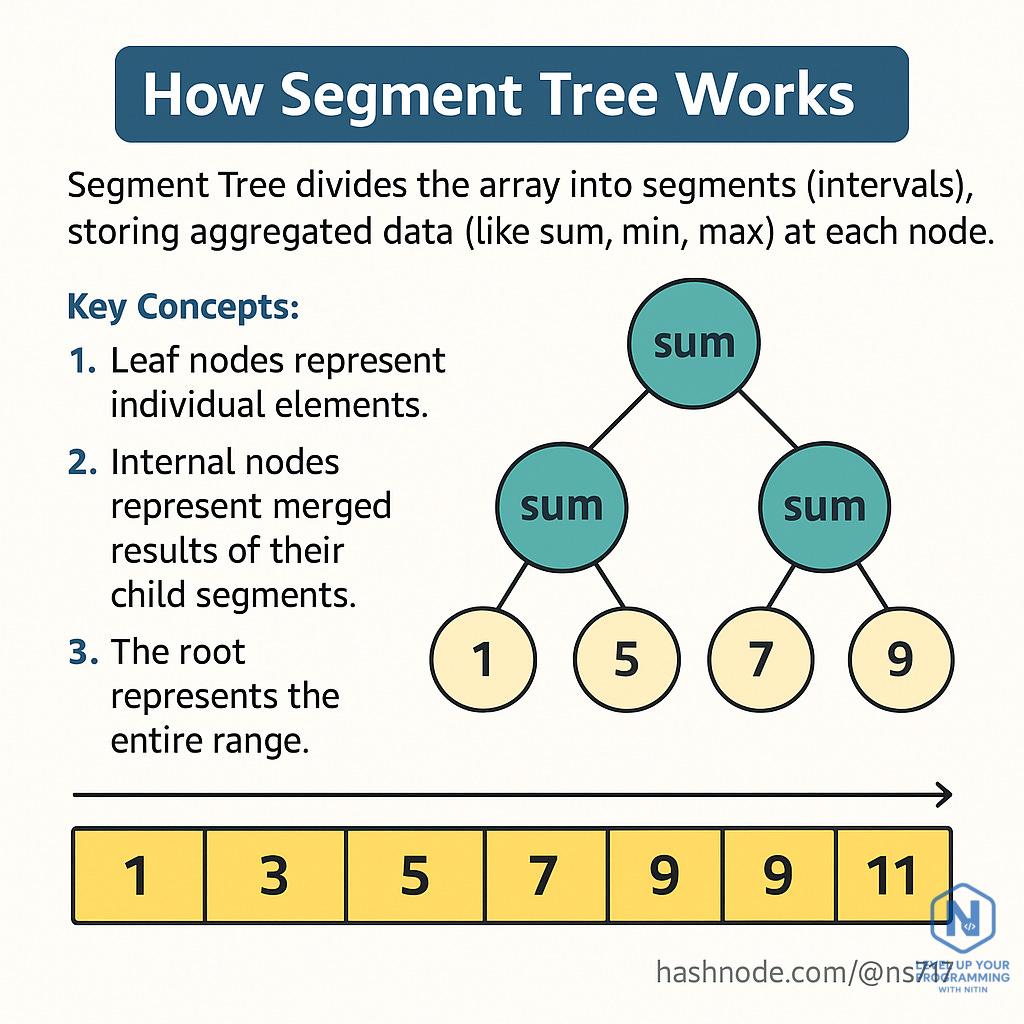
Segment Tree divides the array into segments (intervals), storing aggregated data (like sum, min, max) at each node.
Key Concepts:
Leaf nodes represent individual elements.
Internal nodes represent merged results of their child segments.
The root represents the entire range.
⚙️ Operations
1. Build
Description: Construct the segment tree from an array
Time Complexity: O(n)
2. Query
Description: Find a value in a range (e.g., sum, min, max)
Time Complexity: O(log n)
3. Update
Description: Update a single element or a range
Time Complexity: O(log n)
✍️ Java Code Example
class SegmentTree
{
    int[] tree;
    int n;

    SegmentTree(int[] arr)
    {
        n = arr.length;
        tree = new int[4 * n];
        build(arr, 0, n - 1, 0);
    }

    void build(int[] arr, int start, int end, int index)
   {
        if (start == end)
        {
            tree[index] = arr[start];
            return;
        }
        int mid = (start + end) / 2;
        build(arr, start, mid, 2 * index + 1);
        build(arr, mid + 1, end, 2 * index + 2);
        tree[index] = tree[2 * index + 1] + tree[2 * index + 2];
    }

    int query(int l, int r)
    {
        return queryUtil(0, n - 1, l, r, 0);
    }

    int queryUtil(int start, int end, int l, int r, int index)
    {
        if (r < start || l > end) return 0;
        if (l <= start && end <= r) return tree[index];
        int mid = (start + end) / 2;
        return queryUtil(start, mid, l, r, 2 * index + 1) +
               queryUtil(mid + 1, end, l, r, 2 * index + 2);
    }

    void update(int pos, int val)
    {
        updateUtil(0, n - 1, pos, val, 0);
    }

    void updateUtil(int start, int end, int pos, int val, int index)
    {
        if (start == end)
       {
            tree[index] = val;
            return;
        }
        int mid = (start + end) / 2;
        if (pos <= mid)
        {
            updateUtil(start, mid, pos, val, 2 * index + 1);
        }
        else
        {
            updateUtil(mid + 1, end, pos, val, 2 * index + 2);
        }
        tree[index] = tree[2 * index + 1] + tree[2 * index + 2];
    }
}
🔁 Real-World Analogy
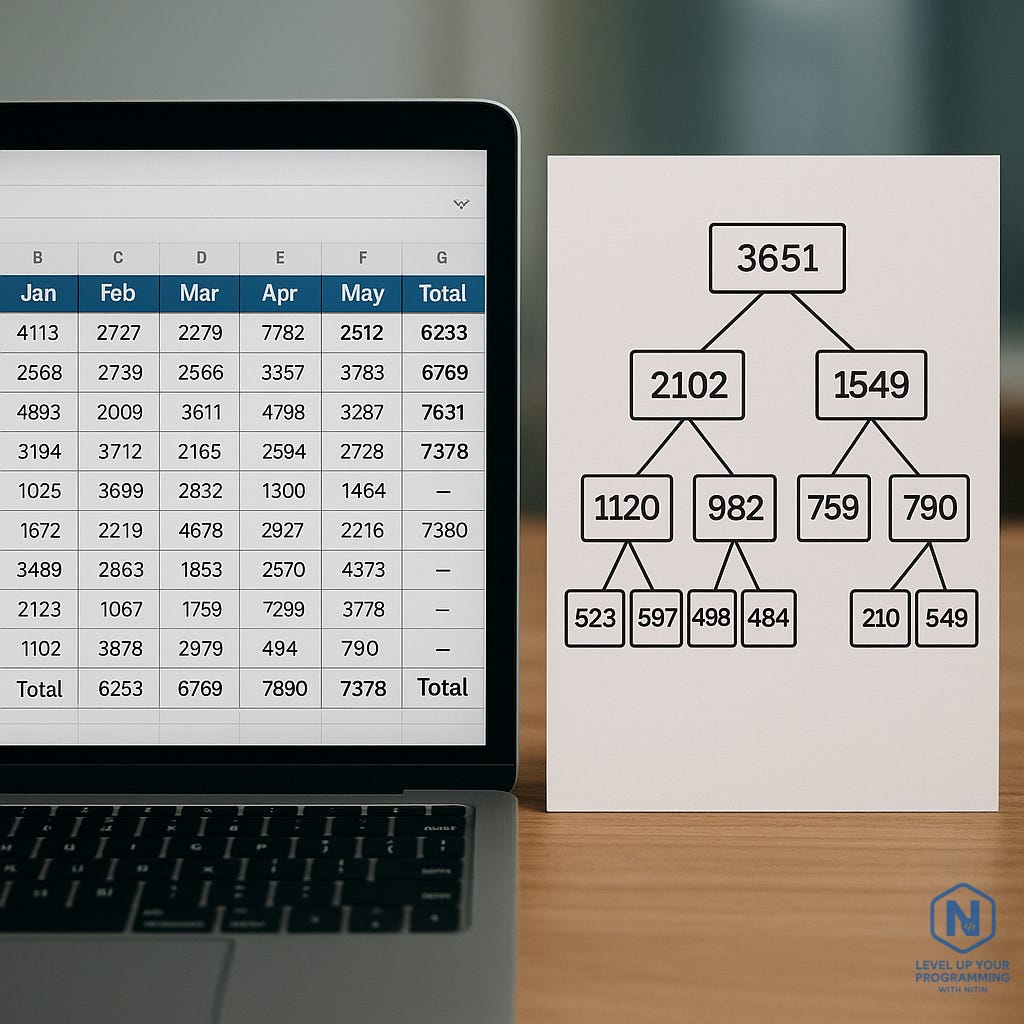
Imagine managing a spreadsheet where each row represents data over time. Instead of recalculating totals every time someone filters by month or week, a Segment Tree pre-aggregates those totals so you can respond in milliseconds.
🧠 LeetCode Practice Problems
Range Sum Query - Immutable – Easy – LeetCode#303
Range Sum Query 2D - Immutable – Medium – LeetCode#304
Range Sum Query - Mutable – Medium – LeetCode#307
Count of Smaller Numbers After Self – Hard – LeetCode#315
Maximum Sum Queries – Hard – LeetCode#2736
✅ Tips for Interview
Corner Cases: Don’t forget to handle edge conditions like out-of-bound indices or overlapping intervals.
Variants: Learn both iterative and recursive implementations.
Lazy Propagation: Know this for range updates—it often shows up in advanced problems.
Know when to use it: Prefer Segment Tree over Binary Indexed Tree (Fenwick Tree) when updates/queries are more complex (e.g., min/max or range update).
🔚 Wrapping Up
Segment Trees are powerful tools in any coder's toolkit—especially for range-based problems that require frequent updates or queries. They provide fast, elegant solutions and are widely applicable in competitive programming and system design.
Happy coding! 🚀
Nitin
Hashnode | Substack | LinkedIn | GIT | Youtube | Instagram