🥞 Understanding Stacks in Data Structures
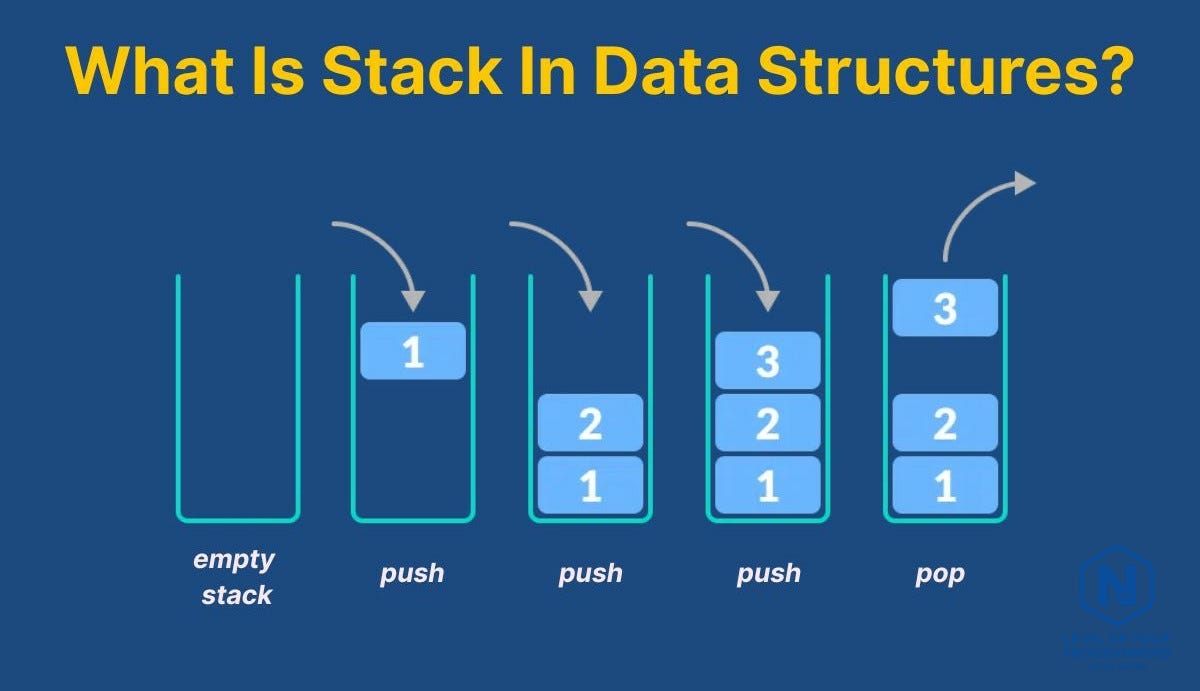
A stack is a linear data structure that follows the Last-In-First-Out (LIFO) principle. Think of it like a stack of plates: the last plate placed on top is the first one you remove.
🧠 Core Concepts
LIFO: Last inserted element is the first to be removed.
Operations:
push(): Add an element to the top.pop(): Remove the top element.peek(): View the top element without removing it.isEmpty(): Check if the stack is empty.
🔍 Core Concepts with Code Samples
We'll use a stack implemented using arrays/lists for simplicity.
✅ Java Code Example
import java.util.Stack;

public class StackExample {
    public static void main(String[] args) {
        Stack<Integer> stack = new Stack<>();

        // Push
        stack.push(10);
        stack.push(20);

        // Peek
        System.out.println("Top element: " + stack.peek()); // 20

        // Pop
        stack.pop();

        // isEmpty
        System.out.println("Is stack empty? " + stack.isEmpty()); // false
    }
}
✅ Python Code Example
stack = []

# Push
stack.append(10)
stack.append(20)

# Peek
print("Top element:", stack[-1])  # 20

# Pop
stack.pop()

# isEmpty
print("Is stack empty?", len(stack) == 0)  # False
✅ C++ Code Example
#include <iostream>
#include <stack>
using namespace std;

int main() {
    stack<int> stk;

    // Push
    stk.push(10);
    stk.push(20);

    // Peek
    cout << "Top element: " << stk.top() << endl;  // 20

    // Pop
    stk.pop();

    // isEmpty
    cout << "Is stack empty? " << (stk.empty() ? "Yes" : "No") << endl;  // No

    return 0;
}
🧮 Stack Operations & Time Complexity
1. Push (Insert)
O(1)
2. Pop (Delete)
O(1)
3. Peek/Top
O(1)
4. Search
O(n)
Stacks are generally implemented using arrays or linked lists. Most programming languages provide built-in stack libraries (like Stack in Java, or deque in Python).
🔄 Memory Layout (Deep Dive)
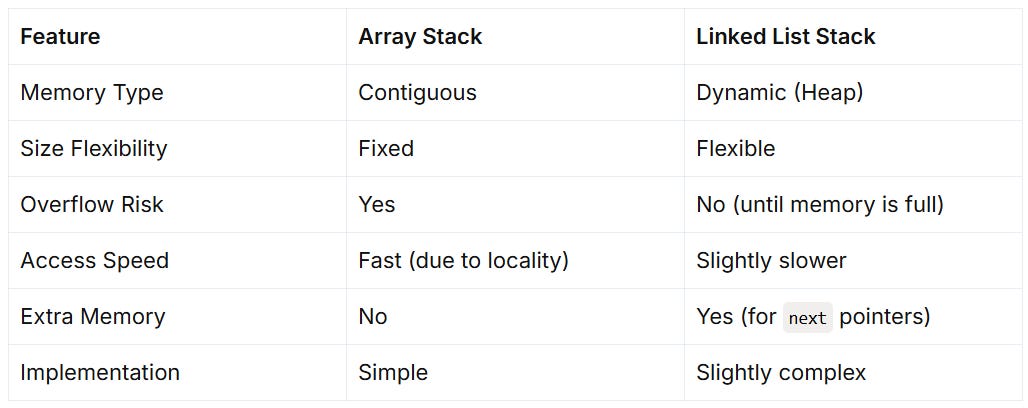
The internal memory layout of a stack depends on how it’s implemented — either using an array or a linked list. Both differ significantly in how they allocate memory and manage elements.
1. 🧱 Array-Based Stack Implementation (Contiguous Memory)
Memory Type: Contiguous (like an array)
Internal Structure: Java array
Behavior:
A fixed-size array is created
A
topindex keeps track of the last elementPush/pop happen at the same end
✅ Java Example:
class StackArray {
    int[] stack;
    int top;

    StackArray(int size) {
        stack = new int[size];
        top = -1;
    }

    void push(int value) {
        if (top == stack.length - 1) {
            throw new RuntimeException("Stack Overflow");
        }
        stack[++top] = value;
    }

    int pop() {
        if (top == -1) {
            throw new RuntimeException("Stack Underflow");
        }
        return stack[top--];
    }
}
📊 Memory Layout:
Index:   0   1   2   3   4
Value:  [ ] [ ] [30][40][50]
Top →                ↑
All elements are in contiguous blocks of memory
Efficient for CPU caching
✅ In Java, using
ArrayListis a common choice when you want dynamic behavior without managing resizing yourself.
2. 🔗 Linked List-Based Stack Implementation (Dynamic Memory)
Memory Type: Dynamic (heap)
Internal Structure: Linked list nodes
Behavior:
Each node contains a value and a pointer to the next node
The
toprefers to the head of the list
✅ Java Example:
class Node {
    int data;
    Node next;

    Node(int data) {
        this.data = data;
        this.next = null;
    }
}

class StackLinkedList {
    Node top;

    void push(int value) {
        Node node = new Node(value);
        node.next = top;
        top = node;
    }

    int pop() {
        if (top == null) {
            throw new RuntimeException("Stack Underflow");
        }
        int val = top.data;
        top = top.next;
        return val;
    }
}
📊 Memory Layout:
[top] -> [50 | →] -> [40 | →] -> [30 | → null]
Nodes are scattered in memory
Each stores a value and a reference
Slightly more overhead due to object and pointer storage
🆚 Side-by-Side Summary
💡 Interview Tip:
Sometimes you're asked to implement a stack using two queues — a great way to test your grasp of queue and stack behavior.
👉 If you'd like a dedicated blog post explaining this in detail with Java code, drop a comment and let me know!
🛠 Real-World Analogy
Imagine a pile of books on a table. You can only take the top one off or add a new one on top — just like a stack.
🧩 Common Stack Use Cases
Undo/Redo in text editors
Backtracking in games and algorithms
Function call stacks in programming languages
Balanced Parentheses and expression evaluation
Depth First Search (DFS) in graphs and trees
📘 LeetCode Practice Problems
Click to open and solve directly:
Valid Parentheses – Easy – LeetCode#20
🎯 Tips for Interview Prep
Mastering stack-based problems requires a solid grip on both implementation details and recognizing when a stack is the ideal data structure. Here are some focused tips to help you stand out during interviews:
✅ Pattern Recognition: Many stack problems revolve around these classic patterns:
Balancing symbols (e.g., parentheses, brackets)
Next greater/smaller element
Monotonic stack (increasing/decreasing sequences)
Reverse Polish Notation (RPN) evaluations
Backtracking or undo operations
✅ Corner Cases to Consider:
Pushing/popping from an empty stack
Dealing with duplicate or invalid inputs (especially in RPN or parentheses)
Implementing
getMin()in O(1) timeEdge behavior for temperature/stock span type questions (e.g., single-day input)
✅ Code Neatness Matters:
Prefer meaningful variable names like
stack,top,index,resultAvoid hardcoding values—make your code adaptable
Write modular functions if time permits (like
isValid(),calculate())
✅ Space vs Time Trade-offs:
Be ready to explain your reasoning if using extra stacks (e.g., for
Min Stack)Always highlight if your solution uses O(n) space or if it's optimized
✅ Dry Run During the Interview:
Walk through your solution out loud using a small input
Highlight how the stack evolves step-by-step—interviewers love clarity
💬 Pro Tip: Interviewers often ask "Can you implement a stack using queues?"
Mention that it's a classic variation and say:
“If you're interested in a detailed breakdown of this, let me know in the comments and I’ll write a separate post!”
🙌 Wrapping Up
Stacks may seem simple at first glance, but they form the backbone of many powerful algorithms and real-world applications. Whether it's balancing expressions, navigating through browser history, or parsing code — stack-based thinking is everywhere in software development.
I hope this post helped solidify your understanding of stacks and how they show up in coding interviews. If you have questions, feedback, or suggestions, feel free to drop a comment — I’d love to hear from you!
📬 Stay updated: More deep-dive posts on data structures are coming soon.
👉 Subscribe to my blog and follow me on LinkedIn to never miss an update.
Happy coding! 🚀
Nitin
Hashnode | Substack | LinkedIn | GIT | Youtube | Instagram